USDA ADU rule: eligible areas by state
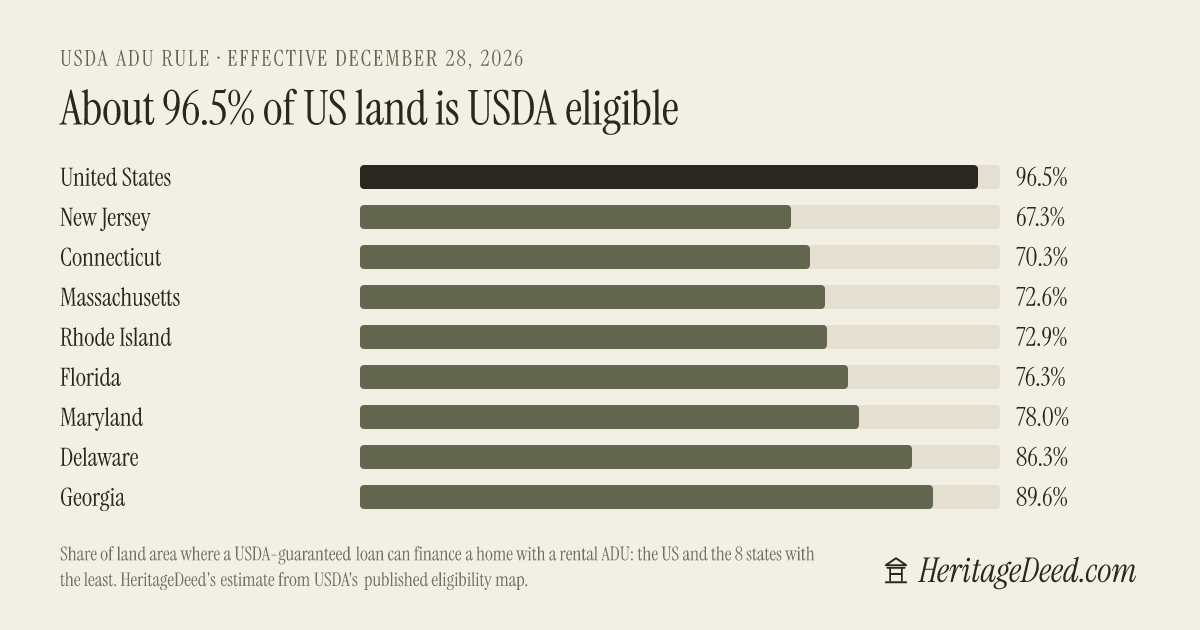
From December 28, 2026, USDA-guaranteed home loans can finance homes with one or more rental accessory dwelling units (ADUs). About 96.5% of US land area is in USDA-eligible rural areas, according to HeritageDeed's analysis of USDA's published eligibility map; the rule changes which homes qualify there, not the map.
What the rule changes
From December 28, 2026, a USDA-guaranteed home loan (Single Family Housing Guaranteed Loan Program) can finance an otherwise qualifying home that has, or will have, one or more accessory dwelling units (ADUs) that earn rent. Until now the program could not finance property that included income-producing land or buildings.
- An ADU is a habitable living unit inside or detached from a single-family home, smaller than the main home, with its own entrance, that is one property with the home (7 CFR 3555.10). A garage apartment, a basement or attic conversion and a backyard cottage are typical.
- The unit must be a living unit: safe water and sewage, heating, hot water, electricity, a kitchen or kitchenette and at least one bathroom.
- A home with design features for a home-based business, such as childcare, product sales or craft production, also qualifies if it needs no commercial real estate features (7 CFR 3555.102(c)).
- Rent the buyer expects from the ADU is not counted as income for the loan: USDA said it will not include potential ADU income in income calculations.
- The property must still be in a USDA-eligible rural area, and the household must meet the income limit. Vacant land, farms and property used mainly for a commercial enterprise stay ineligible (7 CFR 3555.201(b)(2)).
Timeline: proposed March 31, 2026; final rule published October 29, 2026 (91 FR 68025), adopted without change; effective December 28, 2026.
USDA-eligible area by state
The rule applies wherever a property is USDA eligible. Most eligible: Wyoming (99.9%), Montana (99.9%), South Dakota (99.8%), North Dakota (99.7%), Alaska (99.7%). Least: New Jersey (67.3%), Connecticut (70.3%), Massachusetts (72.6%), Rhode Island (72.9%), Florida (76.3%). Each state page has the figure for every county and the towns outside the eligible area.
| State | Land area eligible | Counties eligible in full | Towns mostly outside |
|---|---|---|---|
| Alabama | 94.7% | 45 of 67 | 67 |
| Alaska | 99.7% | 27 of 30 | 4 |
| Arizona | 96.0% | 7 of 15 | 68 |
| Arkansas | 98.3% | 62 of 75 | 24 |
| California | 93.2% | 21 of 58 | 608 |
| Colorado | 96.7% | 52 of 64 | 112 |
| Connecticut | 70.3% | 1 of 9 | 105 |
| Delaware | 86.3% | 1 of 3 | 29 |
| Washington, DC | 0% | 0 of 1 | 1 |
| Florida | 76.3% | 29 of 67 | 566 |
| Georgia | 89.6% | 113 of 159 | 152 |
| Hawaii | 96.6% | 2 of 5 | 19 |
| Idaho | 99.0% | 36 of 44 | 23 |
| Illinois | 91.1% | 76 of 102 | 375 |
| Indiana | 91.8% | 65 of 92 | 125 |
| Iowa | 96.7% | 78 of 99 | 51 |
| Kansas | 98.8% | 92 of 105 | 35 |
| Kentucky | 96.4% | 100 of 120 | 134 |
| Louisiana | 98.0% | 53 of 64 | 19 |
| Maine | 99.4% | 13 of 16 | 6 |
| Maryland | 78.0% | 8 of 24 | 233 |
| Massachusetts | 72.6% | 3 of 14 | 104 |
| Michigan | 95.1% | 59 of 83 | 153 |
| Minnesota | 96.8% | 68 of 87 | 151 |
| Mississippi | 98.5% | 71 of 82 | 19 |
| Missouri | 96.4% | 95 of 115 | 188 |
| Montana | 99.9% | 51 of 56 | 5 |
| Nebraska | 98.7% | 79 of 93 | 23 |
| Nevada | 98.7% | 11 of 17 | 19 |
| New Hampshire | 95.3% | 5 of 10 | 13 |
| New Jersey | 67.3% | 3 of 21 | 388 |
| New Mexico | 98.2% | 23 of 33 | 61 |
| New York | 91.1% | 25 of 62 | 580 |
| North Carolina | 93.0% | 65 of 100 | 111 |
| North Dakota | 99.7% | 48 of 53 | 10 |
| Ohio | 89.9% | 51 of 88 | 346 |
| Oklahoma | 96.7% | 59 of 77 | 37 |
| Oregon | 99.1% | 25 of 36 | 57 |
| Pennsylvania | 94.4% | 39 of 67 | 451 |
| Puerto Rico | 91.7% | 59 of 78 | 38 |
| Rhode Island | 72.9% | 0 of 5 | 11 |
| South Carolina | 93.5% | 26 of 46 | 94 |
| South Dakota | 99.8% | 62 of 66 | 4 |
| Tennessee | 93.2% | 71 of 95 | 53 |
| Texas | 96.1% | 190 of 254 | 299 |
| Utah | 96.6% | 21 of 29 | 80 |
| Vermont | 99.6% | 13 of 14 | 4 |
| Virginia | 92.1% | 83 of 133 | 179 |
| Washington | 97.2% | 24 of 39 | 135 |
| West Virginia | 99.3% | 45 of 55 | 20 |
| Wisconsin | 96.4% | 46 of 72 | 109 |
| Wyoming | 99.9% | 20 of 23 | 5 |
Check an address
Cite this
For journalists, researchers and real estate professionals
- Free to quote and republish, in print, online and in AI-assisted writing.
- Credit HeritageDeed and link the words “HeritageDeed's analysis” directly to this page, so readers can check the figure and look up their own area.
- Online, paste the ready-made version below: it already contains the link. In print, use the reference line.
- Need a figure for another state, county or date, or the method? Write to [email protected].
Questions
What is the USDA ADU rule?
From December 28, 2026, a USDA-guaranteed home loan (Single Family Housing Guaranteed Loan Program) can finance an otherwise qualifying home that has, or will have, one or more accessory dwelling units (ADUs) that earn rent. The final rule (91 FR 68025) was published on October 29, 2026 and adopts the March 31, 2026 proposal without change. It amends 7 CFR part 3555.
When does the USDA ADU rule take effect?
December 28, 2026. The final rule was published in the Federal Register on October 29, 2026.
Does ADU rent count as income for a USDA loan?
No. USDA said it will not include potential income from an ADU in income calculations: lenders may not count income they cannot verify, that is not stable or that is unlikely to continue (7 CFR 3555.152(a)(3)).
Can a USDA loan finance a home with more than one ADU?
Yes. The rule covers an otherwise qualifying property that contains, or will contain, a single or multiple accessory dwelling units (7 CFR 3555.102(b)).
What counts as an ADU under the USDA rule?
An ADU is a habitable living unit inside or detached from a single-family home, smaller than the main home, with its own entrance, that is one property with the home (7 CFR 3555.10). A garage apartment, a basement or attic conversion and a backyard cottage are typical. The unit must be a living unit: safe water and sewage, heating, hot water, electricity, a kitchen or kitchenette and at least one bathroom.
Does the ADU rule change which areas are USDA eligible?
No. The eligible areas stay as mapped: about 96.5% of US land area by HeritageDeed's estimate, with 6,503 cities and towns mostly outside it. The rule changes which homes qualify inside those areas.
Which states have the least USDA-eligible area?
New Jersey (67.3%), Connecticut (70.3%), Massachusetts (72.6%), Rhode Island (72.9%), Florida (76.3%). Washington, DC has none. The share is of land area, by HeritageDeed's estimate from USDA's published eligibility map.
Can a home with a home business get a USDA loan?
A home with design features for a home-based business, such as childcare, product sales or craft production, also qualifies if it needs no commercial real estate features (7 CFR 3555.102(c)).
Is a farm or a rental property eligible under the rule?
No. Vacant land without eligible homes, property used mainly for agriculture, farming or a commercial enterprise, and land or buildings used principally to produce income stay ineligible (7 CFR 3555.201(b)(2)). The home must be the buyer's residence with an ADU that is subordinate to it.
Legal references
- 91 FR 68025 (October 29, 2026), Single Family Housing Guaranteed Loan Program: income producing accessory dwelling units, effective December 28, 2026
- 7 CFR 3555.10, definitions: moderate income and rural area
- 7 CFR 3555.102(b) and (c), loan restrictions: accessory dwelling units and home-based businesses
- 7 CFR 3555.152(a)(3), income that cannot be verified, is not stable or is unlikely to continue
- 7 CFR 3555.201, site requirements: rural areas
- 42 U.S.C. 1490, definition of rural area (Housing Act of 1949, section 520)
Areas are computed by HeritageDeed: estimates, not USDA figures. USDA and the lender decide eligibility for each property and household. HeritageDeed is not affiliated with USDA. Not legal or lending advice.